
Marcus Arcabascio
COO, CoastFi

“From the first call, I knew Jackson was the most knowledgeable person I had talked to about business automation.”
 Schedule a Free Intro Call
Automate the Work Slowing Your Business Down
If your goal is to grow 2-3x in the next year, and manual work is the blocker, I'm your guy.




The Problem
Most manual work doesn't start out as a problem. A task takes five minutes, so someone just does it.
Then the company grows.
Five minutes becomes five hours. One follow-up becomes hundreds. Someone is checking a spreadsheet every morning, another person is copying information between systems, and someone else is reminding people about work that should have happened automatically.
These usually aren't separate problems.
They're signs that too much routine work still depends on someone remembering to do it.
That's what I help fix.
I figure out which work actually needs human judgment, which doesn't, and build automations that handle the repetitive parts reliably in the background.
Sound familiar? Bring me the mess.
Schedule a Free Intro CallProof
The most consistent feedback I get is that I can identify high-friction work quickly, build the right automation without overcomplicating it, and make useful changes fast.
COO, CoastFi
“From the first call, I knew Jackson was the most knowledgeable person I had talked to about business automation.”

Co-Founder & CEO, Tend
“Jackson has the incredible ability to understand business problems, build functional products quickly, and adjust on the fly. I just wish we had found him 6 months earlier.”
Co-Founder & CEO, Storetasker

“Jackson’s superpower is his ability to automate nearly everything he touches.”
Together, We Can Unblock Your Growth
With 10 years of experience growing marketing teams, managing software engineers, and running ops for some of the fastest growing startups in NYC, I have the technical know-how, the core principles, and the battle-hardened experience to create the systems your business needs to keep growing.







All tuned towards one thing: making growing your startup smoother and faster.
But don't just take my word for it...
How I Work
Not abstract recommendations
What I do
What you get
I will look at where time is being wasted, which repetitive tasks keep happening, and where automation would create meaningful leverage without making the system more brittle.
You get a better sense of where automation will actually save time and reduce errors, and where the better answer is to simplify the process instead.
I will work with 2 people on your team: one who sees the bigger picture, understands the goals of the company, and can help me set priorities (the C-suite), and one person who is doing the day-to-day work, feeling the pain of these repetitive workflows, and can give me direct feedback on what is still too manual.
My work will solve for both what matters strategically and what is actually slowing the team down in practice.
I will implement the highest-impact automations directly. That may include triggers, notifications, record updates, status movement, reporting workflows, reminders, integrations, or workflow cleanup around the automation itself.
Your team spends less time doing mechanical work by hand, and the routine parts of the workflow happen more reliably.
I will meet weekly to review progress, align on what comes next, document the system clearly, and train the team so the improvements actually hold up.
You get cleaner execution, stronger team adoption, and a setup that people actually understand and can maintain.
To kick things off, let's get on a free 30-minute call.
For 20 minutes, you can rant to me about what is broken, where the team is getting stuck, and what feels harder than it should. We'll spend the last 10 discussing real solutions to your problems.
I'll see if I can outline actionable next steps that you can implement on your own. If we determine that you need my help, we'll discuss next steps there as well.
You do not need to prepare a deck or organize your thoughts perfectly beforehand. Just come ready to talk through what feels broken, fragile, frustrating, or harder than it should be.
Bring me the bottlenecks, broken workflows, reporting issues, handoff failures, and operational headaches slowing your business down. I will help you get clearer on what is actually wrong and where the fastest wins are.
Schedule a Free Intro CallWhy It Matters
Better automation does not just save a few clicks. It frees up attention, reduces errors, and helps the business run faster without needing more manual coordination.
Automating repeatable tasks lowers the time and cost required to move work forward.
Fewer hand-run steps means fewer missed follow-ups, forgotten updates, and broken routines.
Better automation increases capacity before you need to hire more people.
Work gets triggered, routed, and completed sooner when it does not wait on manual intervention.
Automated systems follow the same rules every time, which reduces mistakes and creates a better customer experience.
When repetitive tasks are handled automatically, people can focus on judgment, service, and improvement.
As demand grows, good automation keeps operations from becoming slower, noisier, and more fragile.
Fit
Companies where repetitive work is wasting too much human attention.
The Results
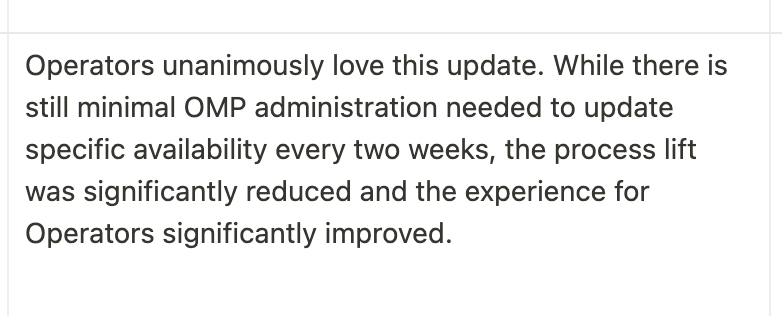
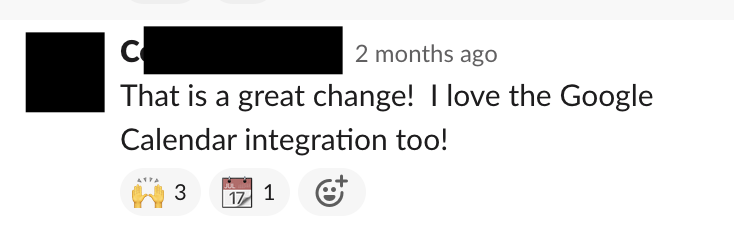
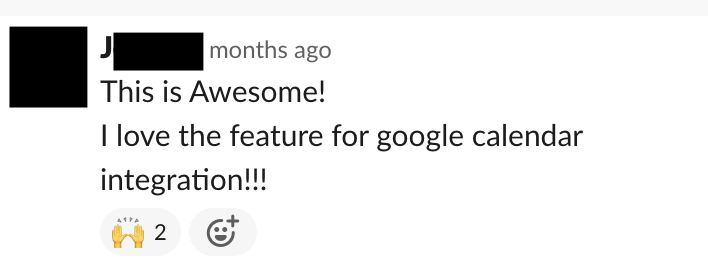
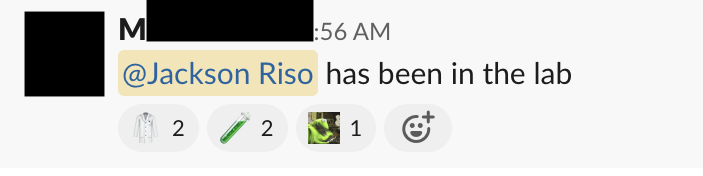
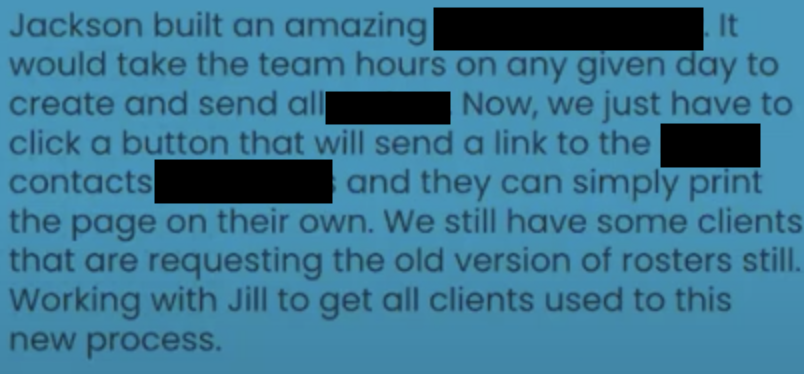
Because my client work is protected by NDAs, I can’t show the exact deliverables. Instead, I’ve included anonymized reactions from real clients to what I built for them. Here are a few more:

FAQ
Over about 30 minutes, you walk me through the repetitive work, manual steps, follow-up gaps, and workflows that keep dragging on the team. I ask questions, help identify the real bottleneck, and aim to give you practical next steps on that first call whether we work together or not.
About 20% of the time, there is a fit, and I will let you know. If you agree, we'll quickly outline what we hope to accomplish in the first 2 weeks to 3 months. From there, we can discuss my month-to-month pricing and begin diagnosing, prioritizing, and implementing the highest-impact changes.
About 80% of the time, potential clients don't actually need my help, they just need to make one simple change. I'll tell you what change to make and send you off to go make it. If, after making that change, you still think you need my help, we can always hop on another call.
Often very quickly. Usually, within the first call. In most cases, I am able to onboard fast, identify meaningful opportunities early, and begin implementing changes within the first 2 weeks.
Currently, I onboard one client per month. If there is a fit, I try to get into the business fast so I can start learning the system, meeting the right people, and identifying the first areas to improve.
You do not need to be involved in every detail, but I do need enough access to understand the business, align on priorities, and get feedback as the work progresses. The goal is not to create more work for you. The goal is to make the right changes with the right level of visibility.
Ideally, I work with one person who sees the bigger picture, understands the company goals, and can help me set priorities (perhaps you?), and one person who is closer to the day-to-day work and can give direct feedback on what is not working.
Both. Part of the process is embedding into the team enough to understand how the work really happens. I work with leadership for priorities and with the people doing the day-to-day work so the automations are grounded in reality.
The best fit is repetitive, rule-based work that happens frequently enough to create drag: follow-up, notifications, record updates, handoffs, reminders, status changes, recurring admin work, and tasks that should happen the same way every time.
Not everything should be automated. If the process is still unstable, if the decision requires judgment, or if the workflow should be simplified before it is automated, I will tell you that. Part of the value is knowing what to automate and what to leave alone.
I start by working with what you have. There are often enormous improvements we can make with your existing tools. If I think a new tool will bring a worthwhile ROI, I'll let you know, we'll discuss it, and I'll present my plan to seamlessly transition over.
Part of the work is building the right amount of automation, documenting it clearly, and training the team on how it works. The goal is not just to make something automated. The goal is to make it reliable and maintainable.
I would lose my mind from boredom if I only advised. I love rolling up my sleeves and getting my hands dirty. I implement the changes directly. I do not just identify what should happen. I help make it happen.
My processes are both internally and externally documented. Internal documentation means that all processes follow a standard format, nomenclature, and numbering system. From within the process, it's easy to see what comes next. External documentation means the process, systems, and decisions are written down clearly enough that the work can be maintained. Training means I work directly with the people who need to use the system so they understand it, trust it, and can run it well.
Yes. The way I work, the team are incentivized to learn the new system. I promise you, your team does not love the repetitive admin work any more than you do. If the automations make their lives easier, they'll be excited to use them. Team training is an important part of the work. Better automation is only useful if the people running the system understand it and trust it.
Start Here
If your team is wasting too much time on repetitive work, missed follow-up, and mechanical tasks that should already be handled by the system, let's start with a 30-minute conversation. Bring me the workflow that keeps dragging on the business, and I will help you get clearer on what is actually broken, so that we can solve it together.
Schedule a Free Intro CallFor nearly every client so far, I have been able to onboard and make improvements within the first 2 weeks.